Research note: This is an editorial buying guide, not a product test. Brand specifications and airline or screening rules come from official pages accessed 16 November 2026. TrekBench has not packed a scored set of cubes for this article. Reddit and similar threads are only a debate signal here, not a source of quotes. No invented affiliate buttons.
Quick answer: For most carry-on suitcases, a small mixed set beats one huge cube: one medium cube for shirts or trousers, one or two small cubes for underwear and socks, and a clean/dirty divider or pouch for worn clothes. Choose compression cubes to shrink bulky knits when the compressed cube still fits the bag’s interior. Choose regular cubes for faster access, less wrinkling, or a backpack that does not benefit from rigid, over-compressed blocks. Cubes do not change an airline’s external size limit and do not replace the TSA liquids bag.
What packing cubes actually change
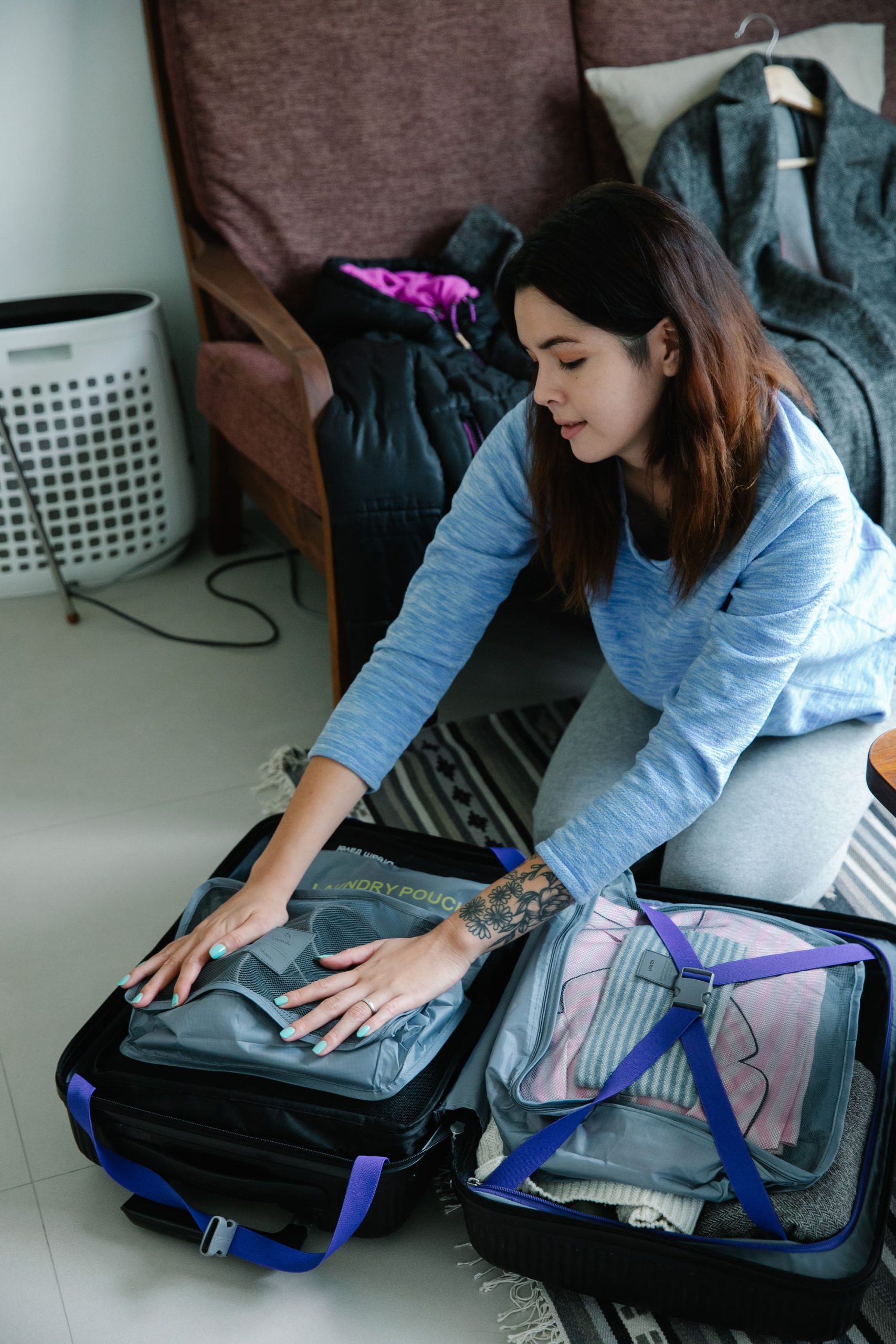
A packing cube is a zippered fabric box that groups clothes by category or by day. The useful effects are organization, compression (if the cube has a second zipper or panel), and the ability to lift one category out of a suitcase without unpacking everything. The effects they do not have: they cannot make a bag that is already over an airline’s linear limit suddenly legal, and they cannot exempt liquids from screening rules.
United Airlines’ official carry-on page, accessed 16 November 2026, says a carry-on must be 9 in × 14 in × 22 in (23 × 35 × 56 cm), including the handle and wheels, and a personal item must be 9 in × 10 in × 17 in. That is one major U.S. carrier’s published limit, not a universal standard. Budget fares and regional aircraft can be stricter, and United notes that Basic Economy usually does not include a full carry-on on many routes. Check the airline and fare you actually booked.
For liquids, the U.S. Transportation Security Administration states that containers of liquids, aerosols, gels, creams, and pastes in carry-on bags are limited to 3.4 ounces (100 milliliters) or less, placed in one quart-sized bag. That is independent of whether the rest of your clothes are in cubes. Keep the liquids bag accessible rather than burying it inside a compressed cube.
Who packing cubes are for — and who can skip them
They are worth considering if you live out of a carry-on for several days, you share a bag and need clear boundaries, you want a clean/dirty split mid-trip, or you already struggle to find items in a stuffed suitcase.
They may not be worth it if you travel overnight with a handful of items, you already roll clothes into a stable packing pattern, you are counting every gram on a backpacking route, or you pack structured garments that show compression wrinkles. An empty cube still has fabric and zipper weight. For weekend trail kits, a single clothing stuff sack plus the packing method in our hiking-backpack packing guide can be simpler. For short outdoor trips that already use a one-bag list, see the one-bag outdoor weekend checklist.
Regular vs compression cubes
A regular packing cube has a single main zipper and holds a relatively fixed shape. A compression cube adds a second zipper, expanding panel, or compression sleeve that reduces the cube’s thickness after it is filled. Official examples help show the scale of the difference without turning this into a brand shoot-out.
Eagle Creek’s official Pack-It Isolate Carry-On Set, listed at $99 on 16 November 2026, includes two small Isolate Compression Cubes, one medium Isolate Compression Cube, and one medium Isolate Clean/Dirty Packing Cube, in 100% ocean-recycled 70D nylon, with the brand’s “No Matter What” warranty language. Official figures: the small compression cube is 10 × 7 × 3 in standard and 10 × 7 × 1 in compressed (3 L to 1 L); the medium is 14 × 10 × 3 in standard and 14 × 10 × 1 in compressed (7 L to 2 L). The clean/dirty cube is 14 × 10 × 4 in and 9 L, with an internal divider rather than a compression zipper.
Peak Design’s official Packing Cube page describes a different brief: a tear-away UltraZip, an internal clean/dirty divider, and a separate expansion/compression zip, in 100% recycled 70D ripstop, Fair Trade Certified, starting at $29.95. Some cubes emphasize shrinking volume; others emphasize fast access and a laundry split in one unit. We have not durability-tested either zipper system.
| Decision | Regular cube | Compression cube | Clean/dirty or divider cube |
|---|---|---|---|
| Main job | Group and stack clothes | Group clothes and reduce thickness | Separate worn and clean items |
| Best in | Suitcases with a predictable interior, or bags where you open cubes often | Carry-ons that are volume-limited but still within the airline’s external size | Trips long enough to accumulate laundry |
| Watch-outs | Takes more depth if you overfill | Can wrinkle structured shirts; over-compression can stress zippers | The dirty side still needs a packing plan so odors do not spread |
| Official example (not a ranked winner) | A standard, non-compression packing cube from any maker that publishes a single-zip design | Eagle Creek Isolate Compression Cube S/M (official 3 in down to 1 in depth) | Eagle Creek Isolate Clean/Dirty Cube M, or Peak Design’s divider-plus-compression design |
Examples and measurements are from official brand pages accessed 16 November 2026. They illustrate types, not a tested ranking.
Size systems: how to build a carry-on set
There is no industry-standard “small/medium/large.” Trust published dimensions, not the name on the label. A practical carry-on set usually uses two or three cubes that lie flat in the main compartment:
- Small (often around 10 × 7 in): underwear, socks, a sleep layer, cables you still want clothed away from liquids.
- Medium (often around 14 × 10 in): shirts, trousers, or a compact mid-layer. Eagle Creek’s official medium Isolate compression cube is this footprint.
- One specialty cube: clean/dirty, or a slim cube that stays in a personal item if the carry-on may be gate-checked.
Measure the bag’s interior, not just the marketing size. A 14 in cube will not sit cleanly in every backpack or under-seat tote. For United’s published personal-item limit of 9 × 10 × 17 in, a 14 × 10 in medium cube is already tight on two axes and may belong in the overhead bag. Leave shoes, toiletries, and leak-prone items out of the cubes.
How to pack a carry-on with cubes
- Check your airline’s carry-on and personal-item limits, including handles and wheels, and any fare rule that removes the overhead bag.
- Set aside the TSA liquids bag and medication you may need at screening. Do not bury them in a compressed cube.
- Fill cubes by category. Roll soft knits; fold structured shirts more loosely if wrinkles matter.
- On compression cubes, close the main zipper first, then compress until the cube is firm, not until the slider fights the tape.
- Place heavier cubes near suitcase wheels, or against a backpack’s back panel, and keep a spare layer near the top if the bag may be opened at the gate.
If overhead bags may be gate-checked, put a change of clothes and essentials in the personal item. United’s official page recommends keeping medication and similar essentials where you can reach them.
Backpacking vs suitcase use
In a suitcase, cubes shine because the shell is rigid and the interior is a rectangle. Cubes become drawers: you can stack them, lift one out in a hotel room, and leave the others closed.
In a hiking or travel backpack, the same cubes can fight the bag’s need to be a soft, irregular volume. A fully compressed rectangle can leave voids, press against your back, or crowd a reservoir or rain jacket. Prefer fewer, smaller, slightly under-filled cubes, and keep sleep systems in the stuff sacks they were designed for. A sleeping-bag compression sack is not a clothing cube. On mixed travel-and-trail weekends, put travel clothes in one or two cubes and keep the trail kit in the pack’s own pockets.
Durability and zippers
Zippers are the common failure point. Eagle Creek highlights a “durable compression zipper,” and Peak Design markets an UltraZip with abrasion-resistant thread. Treat those as manufacturer statements. Zipper life depends on whether the cube is stuffed past a comfortable close, whether grit gets into the tape, and whether you lift a fully loaded cube by one pull. Close zippers before washing if the maker says the cube is washable (Eagle Creek describes the Isolate clean/dirty cube that way), and retire a cube when the tape separates. Eagle Creek’s “No Matter What” language is a brand promise with its own conditions, not an industry standard.
When packing cubes are not worth it
- Ultralight backpacking: cube fabric and zippers can weigh more than the organization is worth. A light stuff sack may be enough.
- Very short trips: one or two nights in a personal item often packs faster without cubes.
- Wrinkle-sensitive clothes: structured shirts or trousers may do better in a folder or on an uncompressed cube.
- Already-tight bags: if the suitcase is at the airline’s external limit, compression helps only the interior, not the shell.
- Fragile zippers: a cube that splits on night two is worse than no cube. Prefer published dimensions and zippers you can inspect in hand.
A simple decision path
- Measure your bag’s interior and write down your airline’s official carry-on rule, not a remembered average.
- If volume is the problem, look at compression cubes with published compressed depth, such as the official Isolate S/M figures above.
- If access and laundry split matter more than shrinking, look at a regular or divider cube (including designs like Peak Design’s combined divider and compression zip).
- Buy the smallest set that covers clothes only. Leave shoes, liquids, and electronics out of the cubes.
- Skip cubes entirely for overnight hops or gram-conscious trail days.
FAQ
Do packing cubes work in a carry-on backpack as well as a suitcase? Yes, if you choose smaller, softer cubes and do not turn the pack into a stack of rigid blocks. Suitcases usually get more benefit because of their rectangular shell.
Will compression cubes get me a larger airline allowance? No. Official size limits, such as United’s 9 × 14 × 22 in carry-on rule, apply to the bag, including handles and wheels. Compression only changes what fits inside.
Can I put toiletries in a packing cube? You can pack solid toiletries in a cube, but TSA’s 3-1-1 liquids rule still requires qualifying liquids to be in containers of 3.4 oz (100 ml) or less inside a quart-sized bag. Keep that bag easy to remove.
Are compression cubes better than regular cubes? They are better at reducing thickness, not at everything. If you open the bag often or pack wrinkle-sensitive clothes, a regular or divider cube can be the more practical tool.
What size packing cubes should I buy first? Start with one small and one medium in a footprint that matches your bag, then add a clean/dirty cube if the trip is long enough to need one. Ignore generic size names until you check official dimensions.
Sources
- Transportation Security Administration, Liquids, Aerosols, and Gels Rule — https://www.tsa.gov/travel/security-screening/liquids-rule (accessed 16 November 2026)
- United Airlines, Carry-on Bags — https://www.united.com/en/us/fly/baggage/carry-on (accessed 16 November 2026)
- Eagle Creek, Pack-It Isolate Carry-On Packing Cubes Set — official product page (accessed 16 November 2026)
- Peak Design, Packing Cube — official product page (accessed 16 November 2026)